
Post
Data is your Operating System
Data foundations aren't an IT project, they are the way you run your business today. Core to strengthening is understanding the components, how they fit together, and what the consequences are of letting it run unchecked
May 4, 2026
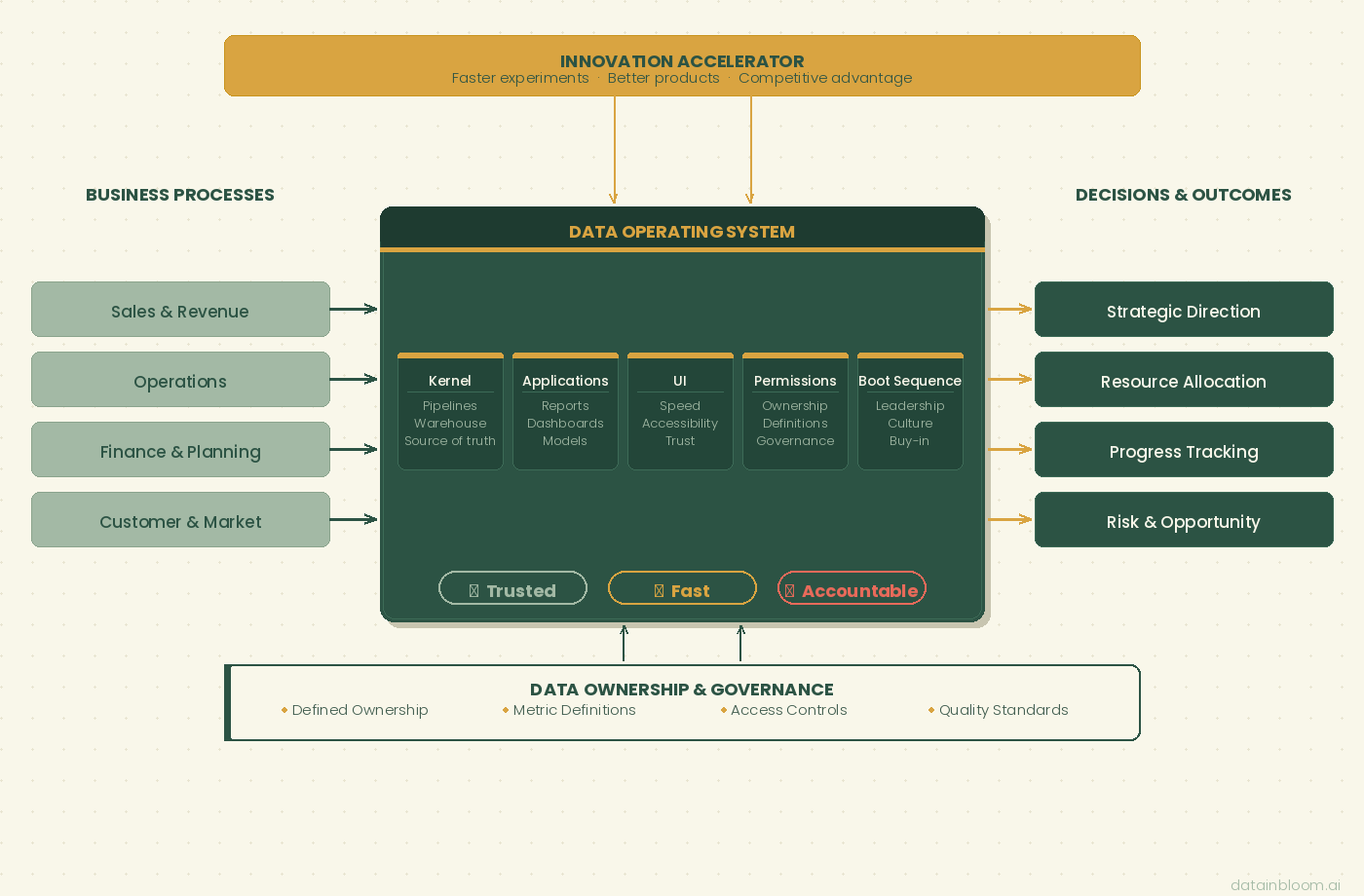
Data isn't a project, it is your Operating System
There's a meeting happening right now at a company somewhere. Maybe it's a pricing review. Maybe a decision about whether to expand into a new market, cut a product line, or reallocate budget. Smart people, experienced people, around a table. Someone has a spreadsheet.
Nobody's sure where the spreadsheet came from. It's probably right. It's probably based on last month's numbers. Someone eyeballed a formula once and it looked fine.
The decision gets made.
This is normal. This is the problem.
Every business already has a data operating system. It didn't get designed — it accumulated. Spreadsheets emailed around. Reports someone built three years ago that nobody wants to touch. A CRM that half the team uses and half the team ignores. A data warehouse that IT manages but nobody in the business fully trusts.
You have an OS. The question is whether it's running or corrupted.
What an Operating System Actually Does
An operating system doesn't do the work. It coordinates everything that does. It manages resources, routes inputs to the right processes, runs applications on a stable foundation, and enforces rules about who can access what. When the OS fails, everything built on top of it fails too.
Data does the same thing for a business. It doesn't make decisions. It determines whether good decisions are possible at all. It manages information flow between functions. It enables the tools your business runs on: forecasting, performance tracking, customer analytics, financial reporting. And when the data foundation is broken, everything built on top of it is unreliable.
The companies that compete on data have figured this out. They're not just "more analytical." They built a functioning OS while their competitors are still running corrupted files and hoping for the best.
The Five Layers of Your Data OS
A real operating system has distinct layers, each with a specific job. So does your data organization, whether you've named them or not.
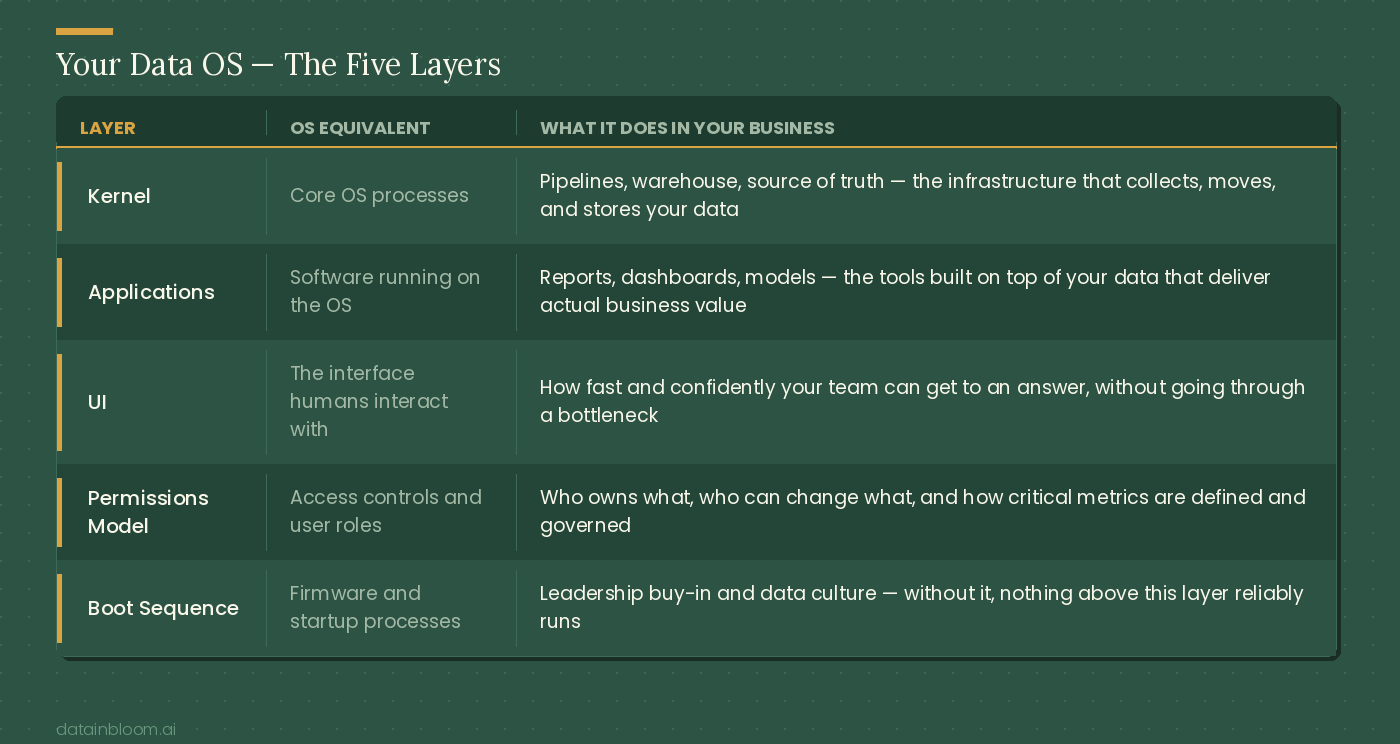
Layer 1: The Kernel — Your Data Infrastructure
The kernel is the core. It's the infrastructure that collects, moves, and stores your data: source systems like your POS, ERP, or CRM; pipelines that extract and load that data somewhere central; and a warehouse or repository that serves as a single source of truth.
Healthy state: Data flows reliably from source to storage. When someone asks "what were our sales last week," there's one place to look and one answer.
Corrupted state: Data lives in twelve places and none of them agree. Finance has one number, operations has another, sales has a third. Every analysis starts with an argument about the data before it gets to the actual question.
If that sounds familiar, you have a kernel problem.
Layer 2: The Applications — Analytics and Models
On top of the kernel, you run applications. Reports, dashboards, statistical models, forecasting tools, and if you're further along, machine learning models in production. These are the things that actually deliver value to the business.
A well-built sales dashboard that a regional manager uses every morning to prioritize her day. A demand forecast that tells the supply chain team how much inventory to move. An anomaly detection model that flags unusual transaction patterns before they become a real problem.
Healthy state: Applications are built with the business user in mind, owned by the people who use them, and trusted because they're built on reliable data.
Corrupted state: Applications were built by IT for IT. Nobody in the business actually uses the dashboards because they don't trust them, can't find them, or can't interpret them. The CEO still sends a Slack to an analyst asking them to pull a number by hand.
This layer fails not because of bad technology. It fails because it was built for the wrong audience.
Layer 3: The UI — How the Business Touches Data
Every OS has a user interface. It's the point of contact between the machine and the human. For your data OS, this is how leaders and operators actually interact with information: the speed at which they can get an answer, the accessibility of the tools, and whether they trust what they see.
This layer is underrated. You can have a solid kernel and sophisticated applications and still fail here. If a VP has to wait three days for an analyst to build a report, that's a UI failure. If the dashboards are technically accurate but nobody understands what they're measuring, that's a UI failure. If every data request goes through a ticket queue, that's a UI failure.
Healthy state: The right people can get to the right information quickly and confidently, without a data team bottleneck in the way.
Corrupted state: Data is a resource you request, not a tool you use. Decision-making slows down not because of the decision itself, but because of the time it takes to get the information needed to make it.
Speed matters here. But trust matters more. Fast access to data nobody believes is worse than slow access to data everyone trusts.
Layer 4: The Permissions Model — Ownership and Governance
Every OS has a permissions model: rules about who can read, write, and execute. Your data OS needs the same thing, and most companies have never actually built it.
This isn't just about security. It's about ownership. Who owns the definition of "revenue"? When finance and marketing calculate it differently, who decides? Who is accountable when a critical report turns out to have been wrong for six months? Who decides what data gets collected, how long it's retained, who can access it?
Healthy state: Data ownership is explicit. Business domains own their data products, not IT. There are agreed definitions for critical metrics. When something breaks or contradicts, there's a clear accountability chain.
Corrupted state: Nobody owns it, so everybody and nobody does. The word "governance" triggers eye-rolls because it sounds like compliance overhead, not what it actually is: the rules that make the OS trustworthy.
The absence of a permissions model isn't neutral. It means every team is running their own version of reality. And nobody finds out until the numbers don't match in a board meeting.
Layer 5: The Boot Sequence — Leadership and Culture
Here's the layer most data frameworks skip, because it's the uncomfortable one.
An OS doesn't run without power. Without the boot sequence, nothing loads. For your data OS, that's leadership buy-in and data culture. Whether the CEO asks for data before making decisions or after. Whether there's a senior leader who owns the data function as a business function, not a technology project. Whether the organization treats "we don't have the data to answer that" as a problem worth solving or a reason to stop asking.
Healthy state: Leadership models data-driven decision making. The data function has a seat at the table, not buried in the IT org chart. Data quality is treated as a business problem, not a technical one.
Corrupted state: Data is a "tech initiative." It lives in a budget line under IT. It gets prioritized when convenient and cut when the business is busy. The boot sequence never fully completes, and everything that depends on it runs in degraded mode.
You can hire the best data engineers in the world. If the boot sequence is broken, the OS won't function.
The Spectrum Is Not the Point
Before you object that your company isn't sophisticated enough for all of this: stop.
The OS analogy works across the entire maturity spectrum. Your kernel doesn't have to be a cloud data warehouse with a transformation layer on top. It can be a well-maintained Excel workbook with a clear owner and a disciplined update process. Your applications don't have to be real-time ML models in production. They can be three clean reports that every manager trusts and actually uses.
Maturity level is not the point. Intentionality is the point.
A simple data OS that is owned, maintained, and actually used beats a sophisticated one that nobody trusts. The question isn't "are we doing enough data stuff." It's "does our data OS work."
In cannabis specifically, this dynamic shows up constantly. Multi-state operators often built their kernel accidentally, cobbled together as the business scaled, then skipped straight to dashboards and reporting layers because that's what leadership asked for. The result is sophisticated-looking applications running on an unstable foundation. The numbers look like data. They don't behave like data.
The Real Problem: IT Owns the OS, the Business Doesn't
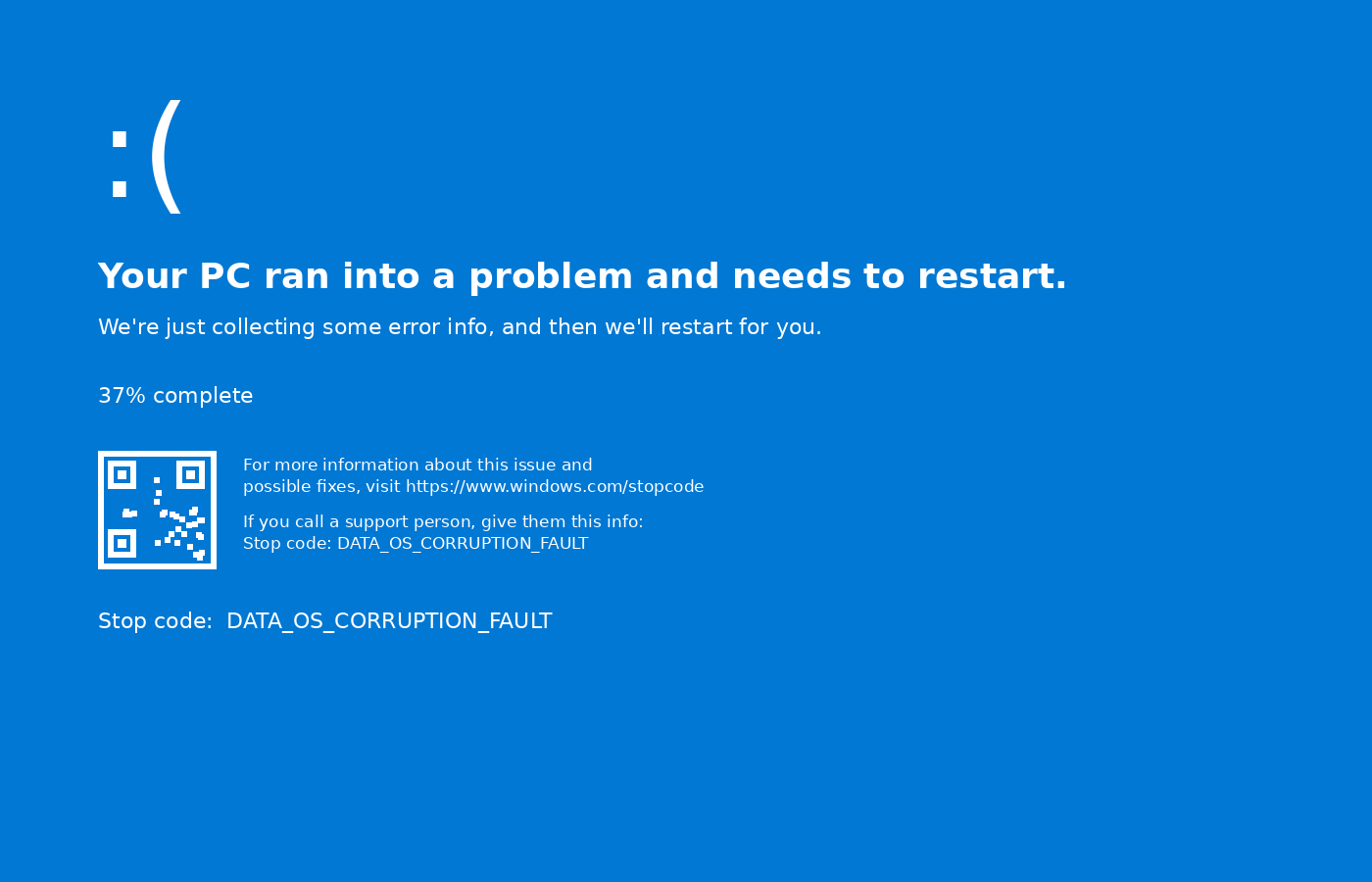
Here's why most data initiatives fail, stated plainly: companies handed data to technology teams because it felt like a technology problem.
It isn't.
The technology is the implementation. The business owns the outcomes. And when you outsource ownership of your data OS to IT, you end up with an OS optimized for technology, not for decisions, not for strategy, not for the questions the business actually needs answered.
It's like outsourcing your P&L to accounting and never reading it. The mechanics are being handled. The accountability isn't.
This isn't a criticism of technology teams. Most of them are doing their jobs well. The problem is structural. When data lives in IT, it gets prioritized like IT work. It competes with infrastructure maintenance and helpdesk tickets, not with revenue targets and strategic initiatives.
The fix isn't a new technology. It's a decision about ownership. A senior business leader, not a CTO, not a VP of Engineering, has to own whether the data OS is working. That person has to be accountable for the quality of decisions that data enables.
In most companies, that person doesn't exist. That's the gap.
Data in Bloom Strategies helps cannabis operators and mid-market companies build data functions that actually work, from the kernel up. If you're not sure whether your data OS is running or corrupted, that's usually worth finding out.